TSS - Canada Reads: Spotlight on The Book of Negroes (& special contest)

The Book 
The Book of Negroes
  
Lawrence Hill 
HarperCollins 
© 2007

“Let me begin with a caveat to any and all who find these pages. Do not trust large bodies of water, and do not cross them. If you, dear reader, have an African hue and find yourself led toward water with vanishing shores, seize your freedom by any means necessary.”


When Aminata Diallo sits down to pen the story of her life in London, England, at the dawn of the nineteenth century, she has a world of experience behind her. Abducted from her village in West Africa as an eleven-year-old child and forced to walk in a coffle – a string of slaves – for months to the sea, Aminata is put to work on an indigo plantation on the sea islands of South Carolina. She survives by using midwifery skills learned at her mother’s side and by drawing on a strength of character inherited form both parents. But Aminata remains trapped, narrowly avoiding the violence that cuts short so many lives around her. Eventually, she has the chance to register her name in the “Book Of Negroes,” a historic British military ledger allowing 3000 Black Loyalists passage on ships sailing from Manhattan to Nova Scotia.


This remarkable novel transports the reader from an African village to a plantation in the southern United States, from a soured refuge in Nova Scotia to the coast of Sierra Leone, in a back to Africa odyssey of 1200 former slaves. The Book of Negroes introduces one of the strongest female characters in recent fiction, a woman who cuts a swath through a world hostile to her colour and her sex.


Mother – Daughter (in law) Book Chat


Instead of the traditional book review, I decided to provide some highlights of a discussion I had with my mother-in-law Alvina, who shares my passion for reading. Her home is truly a book-lover’s paradise, with reading materials nestled in every cranny, fiction and non-fiction covering an array of topics, lands and eras. And once you’ve found a novel to spend some time with,  there is her personal hideout - a beautifully designed den awaiting any bibliophile’s arrival, complete with floor to ceiling bookshelves, and a deliciously comfy leather chair to curl up in while reading.
Exploring the themes and history behind this novel with her, provided me many insights into the story that I had not thought of during my reading. It was terrific to share our thoughts on the topics that Lawrence Hill covers in his novel, as our reading, and personal, histories provided contrasting, yet complimentary views and opinions.

Canada Reads is an event that Alvina introduced me to a few years back, so when I asked what motivated her to read The Book of Negroes I already had a pretty clear idea that she had read it as one of this years line-up. However she also stated that her enjoyment of the Canada Reads event was a terrific way of being introduced to books and authors that she otherwise may never have experienced. She recalled being a follower of Canada Reads since Michael Ondaatje’s novel In The Skin of A Lion won the competition in 2002.

Having finished The Book of Negroes long before me, I asked Alvina what she enjoyed most from the book. It was the research that the author put into the novel that first came to mind, which I enjoyed hearing about because it wasn’t something that I had put much thought into. Alvina goes on to describe that Lawrence Hill showed a dedication to the historical accuracy of his book by making sure he had every detail strongly resolved before setting his story in motion. The presentation of the story and it’s historical perspective was also given without an accusatory tone, rather it was a well-rounded tale of one woman’s life and struggles during a horrible time.

Another thing, that Alvina enjoyed while reading was the writing style itself. Although it is filled with factual and historical incidents covering a long period of time and many different locales, it had a polished style that was easy to read and follow. The story being told from the main characters, Aminata’s, point of view was also wonderful as her recurring journal style narrative kept the story flowing smoothly.

When discussing Aminata, the main story-teller, Alvina was incredibly impressed with how strong this woman was. Her will to survive despite the tumultuous life she has been handed is extremely admirable. Aminata is unwilling to let life’s hardships break her, and struggles to overcome what holds her back. I found it especially interesting when Alvina noted that not only is Aminata’s determination applaudable, but also that of many of the secondary characters in the novel, because not only does the author show the trials the slave must face, but also that of other individuals involved, which is a perspective not often visible.

The Book of Negroes is a book that shows a part of history that many feel has no positive side, so when I asked Alvina what her favourite or most memorable part of the story was I wasn’t expecting such an insightful answer.  But her answer made me consider how Aminata really was an exceptionally strong woman to persevere and find happiness in a situation that seemed to defy comfort or pleasure. Alvina’s answer to my question was to point out a part of the story in which Aminata has found a structured and safe life as a slave. She is not a free person, yet she is free from fear and manages to maintain a strong friendship, and also develop a relationship with a local gentleman. Alvina found this part of the book was enjoyable because it again showed Aminata’s strength to find happiness and live her life fully.

Alvina also mentioned how intrigued she was by Aminata’s descriptions of returning to her African home, to search out the tiny village of her youth. It was the characters resolve to find her heritage and put to rest the questions that had followed her throughout her life. Was her homeland what she remembered? How had things changed in her absence and would she find happiness upon returning to the place she had often dreamed of?

In the end, The Book of Negroes was not what Alvina had expected, but it was a story that she enjoyed more than she had anticipated. Her copy will retain a spot in her library, as she feels the book has much to be gained from future readings. When asked who she thought the book would be a good read for, Alvina’s first comment was one that I agree with fully; you do not need to be of African ancestry to enjoy this. The Book of Negroes is a wonderful look into the life of a slave, but also it provides a great perspective of all heritages, from British, Canadian, American and African, that were involved in this particular historical time. The Book of Negroes is a novel that can be read both as an educational text and as a moving story of personal strength.

So there you have it, I know I left out a lot of things we discussed, but I think this covers some of the most important aspects of our discussion. I hope that you enjoyed reading this re-cap, as much as I enjoyed participating in it.

Huge thanks to Alvina for having me over for a book chat! I enjoyed myself so much, I’m thinking we are totally gonna have to do this again – considering the size of your TBR pile I know we can find out another book to read and chat about over frozen yoghurts xoxox


About The Author 
Lawrence Hill
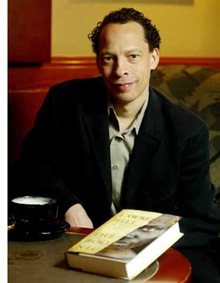
 

Lawrence Hill’s fiction and non-fiction books have received glowing reviews, won numerous awards and brought him a legion of fans.
Hill’s writing often explores issues of identity and belonging, as in his first two novels: Any Known Blood (1997) and Some Great Thing (1992), which was read on CBC Radio’s Between the Covers.
His bestselling memoir, Black Berry, Sweet Juice: On Being Black and White in Canada (2001), describes the lives of his black father and white mother, who emigrated from the U.S. to Canada.
The Book of Negroes, Hill’s third novel, was selected as one of the year’s best books by the Globe and Mail, the Ottawa Citizen and Quill & Quire. Published as Someone Knows My Name in the U.S., the book has proven equally popular south of the border.
Hill began his writing career as a reporter for the Globe and Mail and the Winnipeg Free Press. He has won a National Magazine Award, as well as an American Wilbur Award for his film documentary, Seeking Salvation: A History of the Black Church in Canada.
His most recent non-fiction book, The Deserter's Tale: the Story of an Ordinary Soldier Who Walked Away from the War in Iraq (2007), was co-written with Joshua Key and released in Canada, the U.S., Australia and numerous European countries. Hill grew up in Don Mills, Ontario, and now lives in Burlington, Ontario

Official Lawrence Hill Website

Lawrence Hill is very involved with school, and literary conferences as a speaker and also participates in book festivals giving readings and appearing in discussion panels. Check out his schedule here to find out about upcoming events where Lawrence Hill will be appearing.

Also highly recommended is the collection of audio clips to be found at the CBC online media archives. Some of the highlights include a passage read by the author, an explanation that gives a view on why The Book of Negroes has a different title for the US release, and also a clip of Hill discussing why story-telling is such an important thing for Aminata, the main narrator from The Book of Negroes.

The above video is an terrific interview with Lawrence Hill that I found via watchmojo.com and wanted to share.

About The Panelist
Avi Lewis

Avi Lewis is an incisive speaker and thinker, and for almost two decades, he’s used those skills as the host of a series of television programs — at home and abroad.
In 2008, Avi hosted the weekly television show Inside USA on the Al-Jazeera English television network. The series examines the issues at stake in the U.S. presidential election, taking Avi across the Americas, from Appalachia and Hawaii to Argentina and Haiti.
Avi’s previous programs include On The Map with Avi Lewis (international news analysis, 2007), The Big Picture with Avi Lewis (documentaries combined with town hall debates, 2006) and counterSpin (current affairs discussion, which Avi hosted and produced, 1998-2001). All three programs aired on CBC Newsworld.
Avi also hosted The New Music on Citytv (1996-98), and won a Gemini Award for his coverage of the 1993 federal election as MuchMusic’s political specialist.
He received another four Gemini nominations in 2004 for his first feature documentary, The Take. The documentary follows Argentina’s new movement of worker-run factories, and it won the International Jury prize at the American Film Institute festival in Los Angeles.

Avi Lewis presents 4 reasons why you should read The Book of Negroes in an interesting article on the Canada Reads 2009 blogsite. Here is a short summary of those reasons:

  • First, it’s a totally gripping page-turner of a novel.
  • Second, the central character Aminata Diallo is an unforgettable, original voice with a capacity for insight that rings as true as the call of a circling bird.
  • Third, the novel complicates one of our cherished Canadian myths. Ask any Canadian about slavery, and two of the first words you’re likely to hear are “Underground Railroad.”
  • Finally, the novel transports us into the living, breathing reality of one of those monumental historical facts that is too easy to file away in our minds and hearts with thumbnail images of frozen suffering.

I highly recommend reading this article in it’s entirety, and getting Avi’s full perspective on these 4 reasons.

And because I’m always thinking of songs that go along perfectly with books while I’m reading, here are some songs that Avi Lewis suggests for a playlist to accompany The Book of Negroes:


The Giveaway

Now, the official Canada Reads 2009 debates are coming up soon (March 2) and I’m just over halfway done with the books, so I thought it would be the perfect time for a giveaway! But you’re gonna half to work for this one :)

Just recently when I was reading through the Canada Reads blog, I came across a post where the blogger, Lee, discusses how Lawrence Hill’s The Book of Negroes and Margaret Atwood’s The Handmaid’s Tale share the similarities of being stories told from the perspective of strong females who both must try to conquer a life of hardship and persecution.

There is a particular passage from The Book of Negroes where the main character says “I have long loved the written word, and come to see in it the power of the sleeping lion. This is my name. This is who I am. This is how I got here. In the absence of an audience, I will write down my story so that it waits like a restful beast with lungs breathing and heart beating.”

Lee responds to this by saying “I think it’s that idea, above all, that I loved best in these two seemingly disparate books. It’s also why I get a bit testy when I hear of parents complaining about the more challenging titles featured on high school reading lists. Because isn’t the power that comes from words — be they brutal or depressing or political — exactly the kind of power that teens should be armed with as they prepare to graduate from high school?”

Yes, yes the giveaway – I’m getting there! What I would like is your opinion regarding this, it can be a simple sentence or you can rant away. Just read the blog post - Word Power: Lee muses on The Handmaid's Tale and The Book of Negroes and then come back here and let me know what you think.

Up for grabs is 3 copies of The Book of Negroes by Lawrence Hill, so that means I will randomly select 3 commentors to win! This is open to all readers worldwide and I will draw the winners Friday March 6 at midnight.


Previous Canada Reads 2009 Posts


© 2008-2010 Joanne Mosher of The Book Zombie. All rights reserved.

Review – Skeleton Creek by Patrick Carman

Read.  Watch. Uncover.
 
Skeleton Creek


Something mysterious is happening in Skeleton Creek.
Something scary. Something sinister.

Ryan came close to it … and nearly died.
Now he’s trapped in his house. He can’t
trust anyone – not even himself.

He is forbidden from seeing his best friend, Sarah.
So while Ryan is isolated and alone, she
plunges back into the mystery, putting her
life on the line to get to the truth.

Ryan is desperately trying to write down the full
story. And while he does, Sarah takes videos of what
she finds, then sends him the links so he can watch.

Together, they discover:
The past is dangerous. The present is haunted.
And the future is deadly.


My Thoughts 
When I first heard about this new book from Patrick Carman I was excited to say the least. Having volunteered with a school library I knew about his previous books for children and had seen how much kids enjoyed reading them, especially the Elyon series. So there’s one point for being an author that gets children excited about reading. But I’m a life-long reader and it takes a bit more to get me truly excited about a book, so why was I so worked up awaiting Skeleton Creek? The answer is the format. Books have traditionally been about the writing and the story, but nowadays with most books being translated into the movie format, I’ve seen too many people skipping the books in favour of the film. And with kids this is especially distressing, because not only do they have the option of movies but many books are also making the jump over to video games. What I mean to say is that with technology being a part of our everyday lives it’s easy skip the book, to play the game, watch the movie – but that means you may miss out on the original message that designers and producers did not think crossed over well into their medium. However, Patrick Carman came up with the perfect solution! Why not take all three formats, mix them together and see what happens. And the final product, Skeleton Creek is a phenomenal thing indeed. Check out this video clip, where Carman shares his thoughts on Skeleton Creek’s design.

So, the idea is a great one, but how does it play out? Amazingly! The book starts out with a journal entry from Ryan, his first line: “There was a moment not long ago when I thought: This is it. I’m Dead.” Wow, how’s that for an intro. From there the reader is pulled straight into Ryan’s story. The diary format works really well in making the reader feel they have stumbled upon Ryan’s personal account of what happened. Because of past events, Ryan has been forbidden contact with his best friend Sarah. But kids being kids, they find a way around this using the internet. Sarah, not able to see or phone Ryan uses her video skills to upload filmed messages to her website. Ryan, being the type who wants everything written down, includes website passwords so that Sarah’s videos can still be included in his journal. Along with the passwords, Ryan also prints out hardcopies of relevant emails and clues, which he then glues into his journal. All of this information taken together as a whole, creates a very engaging story, that pulls the reader into an interactive mystery, to find the secret behind Skeleton Creek.

I found myself feeling very connected to Ryan as the story progressed. During his forced separation from Sarah and while reliving the horror of what happened to them, he becomes paranoid and on-edge, as he gathers clues that confuse things even more, he starts to question his own mind and the people he knows. This emotional instability came across wonderfully in the writing. Likewise the videos perfectly capture Sarah’s stubborn drive to uncover what is going on. She is driven, and slightly careless, but as you watch her in the videos you start to form an idea of how successful she could someday become as an investigative journalist. Alone, the two main characters probably have no chance, but together they create the perfect team, one worried and cautious, the other foolhardy and brave. One to consider and tell the story, the other to capture and show it.

Ghosts, gold, secret societies, conspiracies. The ending of Skeleton Creek left me wordless, and I eagerly await the next instalment. Until then, there’s lots of interesting things going on around the internet and I will be watching for the next appearance of Ryan and Sarah.

About The Author
Patrick Carman is the award-winning author of many books for young adults and children. He grew up in Salem, Oregon, and graduated from Willamette University. His birthday is February 27th, 1966. He spent a decade living in Portland, where he worked in advertising, game design, and technology.
Patrick Carman has been a life long writer and storyteller. He writes books for young adults and children for Scholastic and Little Brown Books for Young Readers. His bestselling series include The Land of Elyon, Atherton, and Elliot’s Park. Mr. Carman’s books have been translated into approximately two dozen languages.
Mr, Carman spends his free time supporting literacy campaigns and community organizations, working with Agros.org, mountain biking, fly fishing, doing crosswords, playing Scrabble and basketball, reading, and (more than anything else) spending time with his wife and two daughters.

Title: Skeleton Creek
Author: Patrick Carman
Reading Level: Ages 10 and up
Book Type: Hardcover 192 pages
Publisher: Scholastic Press
Publication Date: February 2009

Explore Skeleton Creek
Skeleton Creek Is Real
Live Friday The 13th Webcast
SarahFincher.Com
Portfolio Days (music from SC)
Sarah @ MySpace
Joe Bush ?

Other Reviews
Book-A-Rama
UnMainstream Mom Reads
Ms. Bookish  
Sharon Loves Books And Cats
YA Fabulous!


© 2008-2010 Joanne Mosher of The Book Zombie. All rights reserved.

Weekly Geeks 2009-05 … Eye Of The Beholder


Judge a Book By Its Cover!
This week it's all about judging books by their covers! Pick a book--any book, really--and search out multiple book cover images for that book. They could span a decade or two (or more)...Or they could span several countries. Which cover is your favourite? Which one is your least favourite? Which one best 'captures' what the book is about?

Further details on Weekly Geeks found here.


I’ve decided to focus on Brave New World by Aldous Huxley.
My favourite covers are #4 and #10, my least favoured are #3, #5 and #9.

If you judged a book by it’s cover, which of these Brave New Worlds would you be more likely to pick up?
Which would you pass right by without a second glance?


#1 – Chatto and Windus 1932 #2 – Bantam 1952
This is a first edition cover and for the age of it I like the use of color as a way of showing separation. 


Lol – I love these pulp-style covers, and as horrid as this looks it does contain the savage, the desirable woman and the modern city in the background.

   
#3 – Flamingo 1977 #4 – Harper Perennial 1998
This is a cover that I hate, the clones are appropriate to the book, but it reminds me of the movie I, Robot (which I was not impressed with)

Clones again, yet I like this cover for the way they are presented as faceless, sexless, and all marching to the same beat. There is something attractive about the color scheme also, with the glare of white representing their ‘good’ origin.

   
#5 – Penguin Readers UK 1999 #6 – Vintage Books 2004

I see this representing one person among a group who cannot conform – but it would be more appropriate to have a male because Lenina, the main female in BNW is more conformist than not.

Again the faceless being is related to everyone being the same and the fetus could be seen as a representation of how babies are  being pre-designed and mass produced. A product rather than a person.
   
#7 – HarperCollins 2004 #8 – Harper Modern Classics 2005
The capsule is a great reference to SOMA – a drug in BNW used to control people. “"All the advantages of Christianity and alcohol; none of their defects."

Since people in BNW were judged alot on materialistic things/looks, this blue-eyed, blond-haired mannequin-like face strikes me as making a connection to the Aryan power movement.

   
#9 – Pearson Longman 2005 #10 – Harper Perennial Modern Classics 2006
More faceless, mannequin like clone troops. Not too original and a bit more bland than the others. The title design in this one is a complete turn-off, it blends into the background and it’s strangely spaced. The mixture of technology with humans is a good connection. The gears could be taken to mean every person is engineered to smoothly interact with all others to make the world one machine comprised of parts that don’t work individually.
   
#11 – Vintage Canada 2007 #12 – Penguin 2008
The egg is another reference to the design and incubation of humans. The zipper perhaps saying that  the human inside has no control, rather it is the creator that decides when they are ready to hatch. This is the only cover that focuses on the creator of the brave new world, although his clones are still present as he seems to watch over them. For me it is a little too reminiscent of 1984’s Big Brother ideal.


© 2008-2010 Joanne Mosher of The Book Zombie. All rights reserved.

Sparkly Vampires … Bleechh

The Twilight Series, I’m sure everyone is completely sick of reading review of these books by now. So, I’m going to keep this quick and short. I just finished reading the last book today. The feeling of relief is immense. But also a feeling of uncomfortable foreboding. The main reason for this is that I’m completely depressed at the world-wide Twilight madness that has taken hold of the younger generation – yes, I know that many adults are in love with the series too, but as adults they are responsible for their own decisions of what they read. Here are some of my main complaints about the series:

  • Bella is a very poor heroine for young girls to look up to.
  • The idea of Bella being so obsessively in love at such a young age.
  • Edward as the ideal boyfriend is beyond thought without Bella having any comparison.
  • The way that Bella so easily leaves family/friends and isolates herself.
  • The idea of using marriage as a way to solve problems.
  • Bella’s lack of parental supervision.
  • Little to no character development, with the exception of Jacob.
  • Certain descriptions being repeated over and over again (OK Edward is beautiful, I get it)
  • The introduction of so many secondary characters with no real background/follow-up.
  • A monotonous ending that seemed to go on forever, with not a trace of tension or action.
  • Sparkly vampires – umm no.

Anyways, those are just things that irk me about the series. My main complaint is that kids (teen girls especially) are going so incredibly crazy about the Twilight series. I didn’t enjoy Bella’s being created as such an obsessive character, but seeing the obsession of fans is tens times worse. If fans were just really excited about the books that would be fine, but when you see kids screaming and fighting over a book or T-shirt, then there is something wrong. Hopefully, these fans have the sense to seperate the fictional characters from the actors portraying them, because these stars aren’t setting too wonderful of an example either.


1125_stewart_0004_Layer_4_full
robert-pattinson-twilight-trouble

Anyways, these are just my thoughts. I didn’t care for these books, but if you do that’s fine too. The world would be a very dull place if we all agreed on everything. Oh and I have to share this totally awesome artist that I stumbled across – Jae Waller – her website is called Mill City Fiasco and she has lots of fun stuff there. Here is one of her comix that I thought was hilarious and is appropriate for this post:

Other Reviews
YA Fabulous!
Kiss My Book

Have you reviewed this book too?
Let me know and I’ll add your link to the list :)


© 2008-2010 Joanne Mosher of The Book Zombie. All rights reserved.

Review – Fairy Tail

Fairy Tail Volume 1
Synopsis

Cute girl wizard Lucy wants to join the Fairy Tail, a club for the most powerful wizards. But instead, her ambitions land her in the clutches of a gang of unsavoury pirates led by a devious magician. Her only hope is Natsu, a strange boy she happens to meet on her travels. Natsu’s not your typical hero–he gets motion sickness, eats like a pig, and his best friend is a talking cat. With friends like this, is Lucy better off with her enemies?


Fairy Tail Volume 2
Synopsis

Beautiful celestial wizard Lucy has teamed up with the crazy fire wizard Natsu and his bizarre flying cat, Happy. Their job: to steal a book from the notorious Duke Everlue. But the eccentric Everlue has killed wizards before, and Lucy’s team is walking right into his death trap!


My Thoughts
The Fairy Tail wizards guild is where everyone with magical tendencies would like to end up, and Lucy is no exception. She dreams of one day being a part of this group. But as amazing as the Fairy Tail guild is, they also have a pretty bad reputation – they seem to be the type that gets a job done with no thought as to the destruction they may cause along the way. They also seem to be a very party and fun oriented bunch.

Volume 1 introduces the reader to three main characters, Lucy, Natsu and Happy. Lucy is a sorceress who uses the magic of her Gate Keys to summon magical spirits. It appears that many of the better Gate Keys call to creatures which are related to star signs. Natsu is a very powerful wizard, raised by a dragon, he has the ability to gain nourishment from eating fire, which also allows him to expel flames from any part of his body. Happy is Natsu’s feline side-kick, his magical talent lets him grow wings that make him able to fly.

Each of these characters have their own particular personality, Lucy acts sort of spoiled, but not in a snobby way, she is very self-confident and likes to think she can get by on her looks alone, even though she seems smart. Natsu is just strange, he is obviously powerful and he loves to fight, and eat, but he cannot travel on any sort of transport without getting sea/car-sick. His background is pretty vague so far, but it’s clear there’s something special about him. Happy is just what his name suggests, an all-around good cat, he provides lots of comical asides.

After reading Volume 1, I was very curious to see where this series was heading. I enjoyed the characters and the basic idea, so I picked up Volume 2. Even though it does introduce more characters and furthers the story, there was just something I wasn’t getting. Maybe if I were to read a few more volumes I would enjoy myself more, but at this point I’m going to set Fairy Tail aside. My only concrete complaint about the series was certain aspects of the illustrations, at points in the story when characters are feeling different emotions there entire persona is drawn differently. The majority of the time they appear as they are portrayed on the covers, but at other times they become cartoonish or sketched looking. This bothers me. I like artistic continuity in my manga.

About The Author
Hiro Mashima is a Japanese manga artist most known for his manga Groove Adventure Rave, published by Kodansha's Weekly Shonen Magazine, from 1999 to 2005. The series was later adapted into an anime. However, the anime adaption was cancelled before it could complete the series. In 2003, he collected some of his one-shot titles in two volumes: Mashima-en- Vol.1 & 2. Those stories include, among others, Cocona, "Xmas Hearts" and "Fairy Tail", a sort of prototype for his last work. In 2006, he began his current ongoing series, Fairy Tail, serialized in Kodansha's Weekly Shonen Magazine. He also published the one-shot manga Monster Soul during the same year.


Title: Fairy Tale Volume 1 & 2
Author: Hiro Mashima
Book Genre: Manga (Japanese)
Book Type: Trade Paperback 208 pages
Publisher: Del Ray
Publication Date: March 2008
Other Reviews
Fairy Tail Volume 1 @ The Written World
Fairy Tail Volume 2 @ The Written World

© 2008-2010 Joanne Mosher of The Book Zombie. All rights reserved.

Library Loot – 04•02•09

Library Loot is a weekly event hosted by Eva of A Striped Armchair and Alessandra from Out Of The Blue.

To take part, simply let everyone know what you discovered on your latest trip to the Library. And don’t forget to check out what great books everyone else checked out this week for ideas for your own future library jaunts.

This fun event happens weekly, from Wednesday through to the following  Tuesday, with a new round beginning the next day. So it’s easy to participate no matter what day you visit the library.

My library visit this week was a quick run in and out, I usually always browse a bit, but when I walked in I saw that I had a ton of books waiting that I had requested online. One great thing about having an online library system is that as I’m reading through blogs and reviews if I spot a book I’m interested in I just pop over to the Library website and place a hold on it.

That picture shows exactly where I sit when I get home from the library. Right down on the floor, like a little kid at Christmas time, with my bookish loot spread around me. So here is what I picked up this week, and why.


© 2008-2010 Joanne Mosher of The Book Zombie. All rights reserved.

Be Careful What You Wish For…

GN_AICN_FixedButton_600x300_ApprovedMock_3DREV

So I had a couple of posts planned for today, a review, my Weekly Geeks post and my first ever Library Loot. I’d planned to come home, eat supper and get blogging… BUT… I scored free tickets to tonight’s special sneak peek screening of Coraline!! In 3D!! I’m so excited I can barely sit still :D


An Adventure too Weird for Words

Anyone else as excited for this movie as I am?


© 2008-2010 Joanne Mosher of The Book Zombie. All rights reserved.

Review – The Westing Game by Ellen Raskin


Synopsis

Where there’s a will, there’s a way – and Sam Westing has left quite a will!

One fateful day, sixteen people gather for the reading of the very strange will of the very rich Samuel W. Westing. To their surprise, the will turns out to be a contest, challenging the heirs to find out who among them is Westing’s murderer – and the winner may become a millionaire! Forging ahead, through blizzards, burglaries, and the attacks of a mad bomber, the race is on. Only two people hold all the clues. One of them is a Westing heir. The other one is you!


Review
The Westing Game is a classic whodunit mystery story. Sam Westing, a millionaire has been murdered and upon arriving at his mansion for the reading of Westing’s last will and testament, an eclectic group of possible heirs discover that old Uncle Sam had a penchant for games. Most of the people gathered together have some connection to Westing, either the fact that they live in Sunset Towers, a building owned by Sam, they may work there, be a cleaning lady, doorman or delivery boy. Others are not so apparent, such as the little girl named Turtle who likes to kick people and play the stock market and Chris a teenager who suffers from a medical condition that keeps him trapped in a wheelchair, unable to talk clearly or avoid what seem to be seizures. But regardless of how they are linked to Sam Westing, he has chosen them to compete in a game, the object is to uncover which of them is responsible for his death, the reward is the title of heir to Samuel W. Westing and two million dollars. When the game begins the sixteen people are put onto teams of two and handed an envelope containing clues in the form of 4 words. The only additional instruction is “It’s not what you have, it’s what you don’t have.”

The mystery, clues, crazy happenings and hidden secrets are all well and good in this book. But, they all take a backseat to the awesome array of characters. Since childhood I’ve been a fan of the movie Clue, and the board game it was based on. What made Clue work was the mixture of personalities and the linking histories behind them. In The Westing House, the reader is swept up in the fast-paced action, as the heirs discover things about themselves and others that they never knew. I think it’s most important to emphasize how they change their own opinions of themselves. For this being written as a children’s book, there is quite a depth of meaning behind the various characters development. It may seem at times that Sam Westing was just a rich old man who wanted to play mind-games with people, but he actually ends up teaching them quite a bit about themselves and their lives. And in the process helping them to become better people, or maybe just guiding them to being the people they were always meant to be.

This is a book that I regret having not read sooner. I chose to read this book as part of the Dewey’s Books Reading Challenge. Dewey stated in her review that she caught on to the mystery of the will early in the story, but then she wrote this:

“I loved the format of the novel, the interesting characters and the sub-plots enough to make up for knowing the mystery of the will, though, and I definitely recommend this for kids, especially those who like mysteries. Or, you know, adults reading all the Newbery books or adults who just like kitdlit.”

That was why I decided to read this book, knowing that Dewey enjoyed and recommended The Westing Game even with the mystery being obvious, was enough to make me realize it would be a terrific book.


About The Author
Ellen Raskin (1928 – 1984) was an American writer, illustrator and fashion designer. She was born in Milwaukee, Wisconsin and grew up during the Great Depression. She married Dennis Flanagan, editor of Scientific American, in 1965. Raskin was also an accomplished graphic artist. She designed dozens of dust jackets for books for 15 years including the first edition of Madeleine L'Engle's classic A Wrinkle in Time. Primarily a children's author, she received the 1979 Newbery Medal for her 1978 book, The Westing Game.


Title: The Westing Game
Author: Ellen Raskin
Book Genre: Children's Fiction – Mystery
Book Type: Paperback 185 pages
Publisher: Puffin Books
Publication Date: 1978
Alternate Covers
Westing Game 4westWesting Game 3Westing Game 2


© 2008-2010 Joanne Mosher of The Book Zombie. All rights reserved.

January 2009 – Reading Recap

Books Read in January 2009

  1. A Bridge Back ♦ Patrick M. Garry
  2. The Darcys & The Bingleys ♦ Marsha Altman 
  3. Living Dead Girl ♦ Elizabeth Scott
  4. Skeleton Creek ♦ Patrick Carman
  5. The Academy ♦ Bentley Little
  6. Ghouls Gone Wild ♦ Tales From The Crypt
  7. Fiction ♦ Ara13
  8. Fairy Tail #1 ♦ Hiro Mashima
  9. Before I Die ♦ Jenny Downham
  10. Can You Fear Me Now? ♦ Tales From The Crypt
  11. Fruit ♦ Brian Francis
  12. This One Is Mine ♦ Maria Semple
  13. Boneyard Volume 1 ♦ Richard Moore
  14. Zombielicious ♦ Tales From The Crypt
  15. No Beautiful Shore ♦ Beverley Stone
  16. Mercy Among The Children ♦ David Adams Richards
  17. Breaking Dawn ♦ Stephanie Meyer
  18. Fat Woman Next Door Is Pregnant ♦ Michel Tremblay
  19. Sister, Wife ♦ Shelley Hrdlitschka
  20. New Dark Voices 2 ♦ Brian Keene (editor)
  21. Children Of Chaos ♦ Greg F. Gifune
  22. Year Of Magical Thinking ♦ Joan Didion


I’m quite pleased with my reading progress so far this year, I’ve relaxed a bit and ignored the fact that my TBR is glaringly over-populated. Taking my time with my reading has improved my enjoyment of the books I’m reading, even if I feel something slightly annoying I can search out the positives, which makes me happy. Adding some graphic novels and young adult into the mix has also helped me to avoid my normal winter blues reading slump.

After taking a look at my stats this month I have found four things I would like to work on in the coming months:
  • Writing a review as soon as I finish a book – this will help me avoid a review back-up and help re-stock my bank of review posts.
  • I really need to add some more non-fiction in, it’s not like I don’t have lots on my shelves waiting.
  • Each month I would like to read at least 3 books from the horror/dark fantasy/fantasy genre. This type of book has always been my comfort read and I’ve neglected it lately.


Weird. Strange. Unusual. Keywords.
I find these keywords posts highly amusing, so I thought I would start highlighting some of the more bizarre things that have led people to my site. This is my first time, I’m not nearly as witty as most of you and my sense of humour has always been a little on the dark side. So here are the ones that made me lol.

2967556701_0a335d5274 "screwed up life of charlie" – No idea who Charlie is, or why he’s screwed but how weird is it that a search term ended up causing me to add a book to my TBR mountain :P

“Oryx And Crake – Endings” – Not to be bitchy but, just read the damn book.

"Bentley Little retiring ?” – OMG I sure hope not!

“New Years gangbang Kentville” – Wow, and here I always thought Kentville was such a pleasant little town.

“Are they making a movie about the book th1rteen r3asons why by jay asher ?” – I don’t know, but I think it’s an awesome idea and I would love to watch it.

“negative review opinion the shack” ✔ “negative reviews on the shack” ✔ “negative reviews to the shack" ✔ “the shack by william young negative reviews” ✔ “the shack did not like” ✔ Plus many, many more. I hated this book, but now I’m wondering if it’s the same person doing all this searching :0

”the shack tricked me” – Yes, yes it did – the cover synopsis for this book is about as fake as those gorgeous girls you see on the front of X-rated movies. What’s really inside is more than likely to burn your retina.

“what's the plural of series” – I have no idea, most of the time I just pop a ‘ at the end.

“Where do i find the book coraline in crawford county” -  Well you could try the library it’s on Plum Street in Michigan. Twelfth Street in Arkansas and McCrary Street in Georgia.

“zombies porno photos” – of for the love of god, there must be 800 hits on my site for this phrase and as much as I love zombies, this is just gross people. Why aren’t you all checking out coroner’s websites or something? Is there really a market for this? Oh who am I kidding, of course there must be.

“Circle of zombies masturbating” – LMAO, ewww, seriously who searches for these things?

“zombie woman porn” – Okay, okay here you go ----------------------->


© 2008-2010 Joanne Mosher of The Book Zombie. All rights reserved.

TSS – Canada Reads: Spotlight on Mercy Among The Children

The Book 
Mercy Among The Children
 
David Adams Richards
Anchor Canada / Random House 
©2000

At the age of twelve, Sydney Henderson pushes his friend Connie Devlin from the church roof. Looking down on Connie’s motionless body, Sydney believes he is dead. Let Connie live and I will never harm another soul, Sydney vows to God. At that moment, Connie stands up, wipes his bloody nose, and with a laugh, walks away. In the years that follow, the self-educated, brilliant and now almost pathologically gentle Sydney holds true to his promise. Yet others in the small rural community regard Sydney’s pacifism as an opportunity to exploit and torment the vulnerable Hendersons. Raised on the books his father has long collected, Sydney’s eldest son Lyle shares a deep respect for the power of words. But forced to witness the persecution of those he loves, Lyle turns his back on God and literature and adopts a more aggressive strategy for the protection of his family. An exploration of how humanity faces inhumanity, how lies and disappointments cannot and will never destroy truth and human greatness, Mercy Among The Children is a novel set in a particular place and time, yet universal in its message.


My Thoughts
Mercy Among The Children, is a very personal look into the lives of a family struggling to live. Their life is a hard one, and their obstacles seem almost unbearable. Set in a small, rural town in the Canadian province of New Brunswick, the Henderson’s have been dealt a hand that most would fold immediately. In a town filled with people who all possess defects and an imperfect way of living, the Henderson’s have become the ones who are targeted for persecution, deserved or not. As though by pointing out their apparent deficiencies the other townsfolk can feel better about their own issues.

This story is told from the point of view of Lyle, the eldest son of Sydney Henderson. Through his words, we learn much of the towns history and how his family came to be viewed so harshly. Lyle describes how his own life has been affected by both his father and his grand-father’s actions. However, the event that overshadows much of Lyle’s life happened before he was even born. His father Sydney, at the age of twelve made a promise to God that he would live a life of gentle, passivity. It is because of this, that Lyle comes to believe the family’s problems have evolved. At first, he agrees with his father and shares his faith, but as he matures and experiences firsthand the cruelty of mankind, Lyle begins to suspect that fighting back is the only way to survive. But does this make you just as bad as your attackers, or does it even matter, when all is said and done?

It would be all too easy to label this as a classic tale of good versus evil, but the depth of this story cannot allow that. There is no good or bad guy present here, all the characters, and all their actions, contain so many different shades of gray, that while reading you will find yourself at a loss as to just who is in the right. I think that this is exactly what makes Mercy Among The Children, such a powerful novel. The circumstances make you think, force you to consider how you would feel, and then change it up just enough to provoke you to view it from another perspective altogether.

Mercy Among The Children was not a book I found particularly easy to read. It shows an ugly side of people and life, but this is one of it’s strong points. The struggles of life are not pretty, and this book shows that in brutal honesty. I liked that the characters all had certain disagreeable characteristics, because it relates well to the real world. We all know that behind most seemingly perfect people, there is bound to be at least one not so nice thing about them. For me, a story is made by the characters it contains, and this novel contains a large cast of original and believable personalities, that pull this story together into something amazing. Character study, family saga and community overview are collectively joined by David Adams Richards smooth writing and provide an extremely stimulating read.


About The Author 
David Adams Richards 

Born in Newcastle, New Brunswick, David Adams Richards says he found his calling as a writer after reading Oliver Twist at the age of 14. He has since published 12 novels and two non-fiction books. Considered by many to be Richards’ most accomplished novel, Mercy Among the Children was co-winner of the Scotiabank Giller Prize in 2000. It also won that year’s Canadian Booksellers Association award for author of the year and fiction book of the year. The Miramichi region is at the heart of Richards’ fiction, and his depictions of the place and its people have garnered him numerous awards and prizes. Notably, he is one of few writers in the history of the Governor General's Award to win for both fiction (Nights Below Station Street) and non-fiction (Lines on the Water). He was awarded the prestigious Canada-Australia Prize in 1992.
Richards has adapted a number of his novels for TV and film, including Nights Below Station Street. Small Gifts brought him his first Gemini, for original screenplay, and his second was awarded for his adaptation of For Those Who Hunt the Wounded Down. He co-wrote the screenplay for the feature film adaptation of The Bay of Love and Sorrows. Richards’ most recent book, The Lost Highway, was longlisted for the 2008 Scotiabank Giller Prize. His previous novel, The Friends of Meagre Fortune, was a Scotiabank Giller nominee in 2006 and won the Commonwealth Writers Prize for Best Book (Canada and Caribbean). He has also written a non-fiction book on the place of hockey in the Canadian soul, Hockey Dreams. Richards now lives in Toronto, but still has a licence to fish the Miramichi River.

On the Canada Reads website there are so many interesting things to learn about David Adams Richards. Being a music lover I was particularly interested in a feature where Richards was asked to compile a playlist that he felt went best with his book, Mercy Among The Children.Here are seven of David Adams Richards Top Ten Playlist suggestions. 

Also don’t forget to check out the CBC Archives for some great audio and video clips from the author, including interviews and a wonderful clip of Richards reading an excerpt from Mercy Among The Children.


About The Panelist
Sarah Slean

Eclectic singer-songwriter Sarah Slean is a creative force to be reckoned with. She has released six recordings (most recently The Baroness, in March 2008), all of which she co-produced, and has garnered two Juno nominations. She has toured extensively across North America and Europe, and has shared the stage with artists such as Blue Rodeo, Alanis Morissette and Bryan Ferry. She has collaborated with several of Canada’s most renowned orchestras, including the National Arts Orchestra and the Toronto Symphony Orchestra. Sarah is also an actor, with a Gemini nomination to her credit for her lead role in the musical film noir, Black Widow. In addition, she is an accomplished visual artist who has exhibited in both solo and group shows. And she’s a poet who has published two collections (Ravens and The Baroness). Sarah studied classical piano at the Royal Conservatory of Music and York University before launching her solo career as a singer-songwriter. She currently studies music and philosophy at the University of Toronto.

And of course, there’s lot’s more to discover about Sarah Slean! Canada Reads asked Sarah what some of her favourite Canadian books were and below you can see what she chose. To read what she had to say about these books head over here. While you’re there you can also see what music this Canadian songstress chose as the perfect companion playlist to Mercy Among The Children.

 
Just in case you haven’t heard how amazing her music is, here is Sarah Slean’s video for Lucky Me, from her 2004 album Day One. If you would like to find out more about her music and her life, she has a wonderful website.


Previous Canada Reads 2009 Posts


© 2008-2010 Joanne Mosher of The Book Zombie. All rights reserved.